
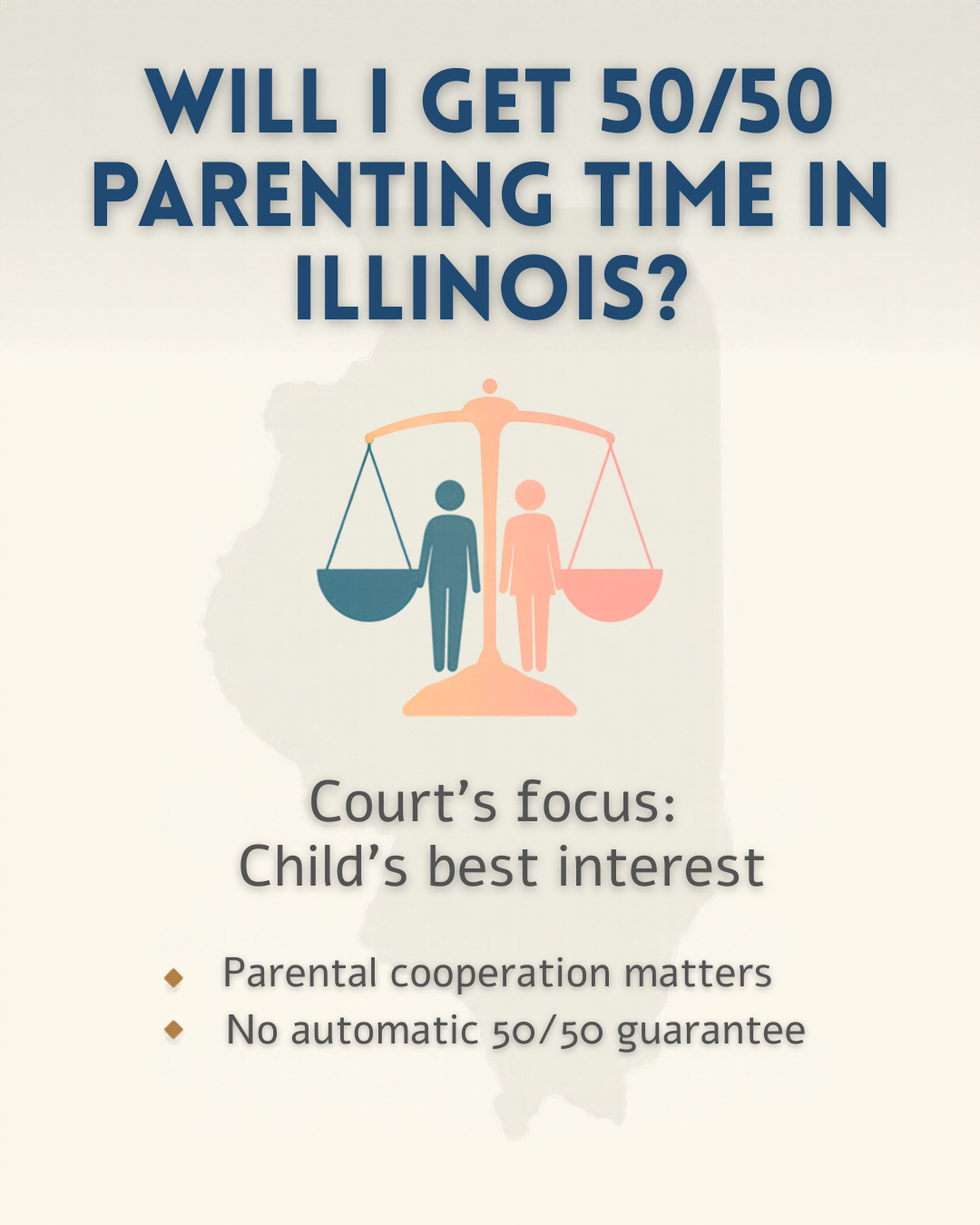
One of the first questions parents ask me when they are considering divorce is, "Will I get 50/50 parenting time?" Behind that question is usually a much deeper fear. Parents are not simply asking about percentages or calendars. They are asking whether they will continue to be an important part of their children's daily lives. They worry about missing birthdays, school events, bedtime routines, and the countless ordinary moments that define a close parent-child relationship. The uncertainty surrounding parenting time often causes parents to believe they must hire the most aggressive attorney they can find.
The reality is more encouraging than many parents expect.
Book a complimentary introduction call or planning session with Erin, here.
Illinois law does not presume that one parent should receive more parenting time than the other simply because of gender or historical stereotypes. Instead, courts are required to determine parenting time based upon the best interests of the child after considering numerous statutory factors unique to each family. That means no attorney can honestly promise a particular parenting schedule because every family's circumstances are different. However, many parents are relieved to learn that the legal system begins with a very different question than they imagined. Rather than asking which parent should "win," the focus is on developing a parenting arrangement that promotes the child's well-being while preserving meaningful relationships with both parents whenever appropriate.
At Birt Family Law, we believe that understanding this distinction changes the entire divorce process. Our Restorative Divorce® process focuses on thoughtful preparation, research-informed strategies, and structured negotiations designed to help parents protect their relationships with their children without creating unnecessary conflict.
Parenting Time Is About Your Child's Best Interests, Not Winning
Many parents understandably approach divorce believing they must prove they are the better parent. While each parent naturally wants to protect the relationship they have built with their children, framing the divorce as a competition often creates unnecessary fear and conflict.
Illinois courts evaluate parenting issues by considering numerous factors that relate to the child's best interests. These factors include each parent's involvement in the child's life, the child's developmental needs, the ability of the parents to cooperate, the child's adjustment to home, school, and community, and many other considerations depending upon the family's circumstances.
When parents understand these principles early, discussions often become more productive. Rather than focusing on defeating the other parent, discussions can shift toward creating a parenting schedule that supports the children's emotional, educational, and developmental needs while allowing both parents to remain actively involved.
Preparation Often Has a Greater Impact Than Aggression
Many people assume that hiring the most aggressive attorney will automatically result in more parenting time. In my experience, that is often incorrect.
Successful parenting negotiations usually begin long before anyone walks into a courtroom. At Birt Family Law, we spend considerable time helping our clients prepare before formal negotiations begin. We identify parenting priorities, understand each child's developmental needs, anticipate areas of disagreement, organize supporting information, and develop parenting proposals that are practical, child-focused, and supported by facts rather than emotion.
Research supports this approach. O'Hara, Sandler, Wolchik, and Tein (2019) found that children's long-term adjustment following divorce is influenced by both the level of conflict between parents and the coping strategies families develop throughout the divorce process. When parents remain locked in prolonged conflict, children are more likely to experience emotional and behavioral difficulties. Conversely, reducing conflict and improving family coping can support healthier long-term outcomes.
Preparation allows parents to negotiate from a position of confidence rather than fear. It also allows discussions to remain focused on solving problems instead of escalating disagreements.
A Successful Parenting Plan Looks Beyond Today
A parenting schedule is much more than a weekly calendar. Children grow older, activities change, parents change employment, and families encounter new circumstances over time. A parenting plan that works well should provide stability while remaining flexible as children's needs evolve.
For that reason, we encourage clients to think beyond today's disagreement. We discuss transportation responsibilities, extracurricular activities, holidays, vacations, communication between parents, methods for resolving future disagreements, and practical solutions that reduce the likelihood of returning to court.
Many of these preparation strategies are reflected in my published resources, including the Co-Parent Decision Toolkit™, Co-Parent Roadmap™, Co-Parent Conversation Guide™, and the 90-Day Restorative Divorce® Workbook. These tools were developed to help parents organize decisions, improve communication, and remain focused on raising emotionally healthy children throughout the divorce process.
If you are asking whether you will receive 50/50 parenting time, you may actually be asking a much more important question: "How do I protect my relationship with my children?"
If you are considering divorce in Wheaton, DuPage County, or anywhere in the greater Chicago area, I invite you to schedule a meeting with me, Erin Birt. Together we can evaluate your family's unique circumstances, discuss your parenting goals, and develop a thoughtful strategy designed to protect your relationship with your children while moving your family toward a positive resolution.
Book a complimentary introduction call or planning session with Erin, here.
Frequently Asked Questions
Is 50/50 parenting automatic in Illinois?
No. Illinois does not automatically order equal parenting time.
What factors determine parenting time?
Courts evaluate numerous factors, including each parent's involvement, the child's needs, each parent's ability to cooperate, and the child's adjustment to home and school.
Does hiring an aggressive attorney increase my chances?
Not necessarily. Well-prepared parenting proposals and productive negotiations frequently achieve better long-term outcomes.
What if my spouse refuses equal parenting?
Each case depends upon its facts. An attorney can evaluate your circumstances, prepare evidence, and negotiate or litigate when necessary.
Can parenting schedules change later?
Yes. Parenting plans may be modified when legal standards are met and circumstances warrant a change.
Book a complimentary introduction call or planning session with Erin, here.


Comments
There are no comments for this post. Be the first and Add your Comment below.
Leave a Comment