
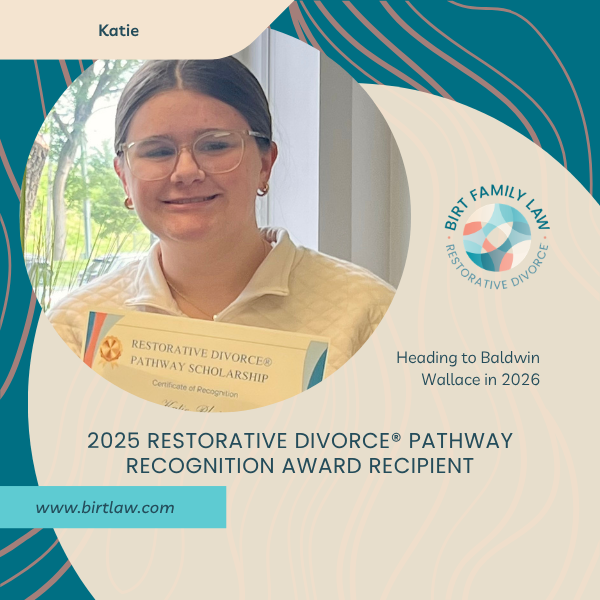
Scholarship Recipient Spotlight: Katie's Story of Resilience Through Divorce and Family Transition
At Birt Family Law and through the Restorative Divorce® Pathway Scholarship, one of the most meaningful parts of this work is hearing directly from young adults whose childhood experiences with divorce shaped the people they are becoming. Recently, we had the privilege of awarding a scholarship to Katie, a remarkable young woman whose essay reflected honesty, resilience, and maturity far beyond her years.
Katie's story is a reminder that divorce itself is not always what children remember most. Often, it is the emotional aftermath, the instability, the silence, the pressure to choose sides, or the feeling of carrying burdens too heavy for a child's shoulders.
The Quiet Impact Divorce Can Have on Children
In her essay, Katie shared that her parents' divorce “wasn't a messy one,” but she explained that the aftereffects stayed with her long after the separation itself. She described being only six years old when her father moved out, trying to understand a life that suddenly felt different and uncertain. Over time, she experienced feelings many children quietly carry during and after divorce: confusion, guilt, emotional responsibility, and the pressure to protect the feelings of the adults around them.
What stood out most in Katie's writing was not bitterness, it was her insight gained. She recognized how deeply childhood experiences shape a child's sense of safety, stability, and emotional development. She described feeling as though the divorce “broke” the foundation she was raised upon, creating “an uneven surface that a child needs to grow on.” That sentence captures something many professionals working with children of divorce have witnessed for years: children often continue growing outwardly while quietly trying to rebuild stability internally.
Katie's essay also touched on another reality many families quietly experience during and after divorce: the emotional struggles parents themselves may face during periods of major transition. She described the pain and confusion surrounding her father's overdose and the guilt she carried afterward as a child, believing she somehow should have done more. Divorce can profoundly affect parents emotionally, financially, mentally, and physically. When adults are struggling with grief, stress, depression, addiction, isolation, or instability, children often feel those effects deeply, even when parents are trying their best. Many children quietly take on emotional burdens they were never meant to carry.
This is one reason child-centered planning, emotional support, healthy communication, and early intervention matter so much during family transitions. Families often need more than legal paperwork alone. They need structure, education, emotional awareness, and pathways that reduce unnecessary escalation before conflict begins reshaping the emotional wellbeing of everyone involved.
As a former Guardian ad Litem and family law attorney who has worked with families for more than two decades, I have seen how easily children can become emotionally overwhelmed by adult conflict, uncertainty, prolonged court battles, or inconsistent communication between parents. Many children never openly say they are struggling. Instead, it appears through anxiety, people pleasing, anger, perfectionism, withdrawal, or feeling responsible for the emotional wellbeing of their parents.
Katie's story also reflects another truth: children are often far more aware than adults realize.
Why Children's Stories Matter
One of the reasons I created the Restorative Divorce® Pathway and began writing children's stories through the Rudy & Ali series was because children need language, comfort, and emotional safety during family transitions. They need reminders that they are not responsible for adult decisions. They need consistency, reassurance, and opportunities to process difficult emotions in healthy ways. Stories matter because children often connect to feelings indirectly before they can verbalize them directly.
A child may not sit down and explain fear, grief, guilt, or confusion in adult language. They may, however, connect deeply with a story about a dog who feels uncertain, a child who misses a parent, or a character trying to make sense of change. Stories create emotional permission and they help children feel seen.
Katie's essay reinforced why this work matters so deeply. Her experience demonstrates that even when parents believe they are protecting children from conflict, children can still absorb emotional strain, instability, and loss in profound ways. It also demonstrates why the legal process alone is often not enough.
Families frequently need structure, education, communication tools, and child-centered guidance long before situations escalate into damaging conflict.That belief is one of the foundations of what I often refer to as Divorce Court Prevention.
Building Stronger Foundations for the Next Generation
What made Katie's essay especially moving was not only her honesty about pain, but her ability to recognize her own growth. Near the end of her essay, she reflected that despite the hardships she experienced, she became resilient and learned to build “a strong foundation” for herself moving forward. That perspective takes tremendous strength.
The purpose of the Restorative Divorce® Pathway Scholarship is not simply to provide financial assistance. It is to recognize resilience, perseverance, and the emotional strength many children of divorce develop while navigating circumstances they never chose for themselves. Katie's story is ultimately hopeful. It reminds us that children can heal, grow, and thrive. It also reminds parents and professionals that the way divorce is handled matters deeply. The words spoken around children matter. The emotional environment matters. The level of conflict matters. The process matters. Children carry these experiences with them into adulthood.
That is why I continue practicing in a manner focused on reducing unnecessary harm, minimizing conflict where possible, and encouraging thoughtful, child-centered decision making before families become trapped in prolonged litigation. When parents are given better tools, better structure, and healthier pathways forward, children benefit too.
At Birt Family Law, the Restorative Divorce® Pathway was created to provide families with structured, child-centered options designed to reduce unnecessary conflict and support healthier long-term outcomes for parents and children alike.
We are honored to recognize Katie for her resilience, perseverance, and bright future ahead. On behalf of Birt Family Law and the Restorative Divorce® Pathway Scholarship, congratulations, Katie. Your story matters, and your strength will undoubtedly continue to carry you forward.


Comments
There are no comments for this post. Be the first and Add your Comment below.
Leave a Comment